Today we’re discussing Track 9: ‘Führer’ by Josh White, an anti-war record that demands your attention through its captivating vocal performance and stunning lyricism. While all of the songs on this album are anti-fascist, this is the first true anti-war song, which was a bold move on White’s part. After the bombing of Pearl Harbor, American nationalism was at a fever pitch, and there was little tolerance for anything but blind support for US involvement in the war. So how did White pull it off? By making an ingenious shift in perspective, which we’ll discuss in more detail below.
If you’re joining us for the first time, welcome! While in one way each discussion will build on the last, ultimately I’ve organized the series in a way that allows each post to stand on its own. If you have yet to listen this excellent compilation, this link will take you to my recreation of it in the form of a YouTube playlist. If you happened to give my channel a follow while you’re there, I’d be much obliged : )
If you’d prefer to start at the beginning of this series, here’s a link to the Introduction.
The Artist
“I spent many, many hours with him in the years of my early development. He had a profound influence on my style. At the time I came along, he was the only popular black folk singer, and through his artistry exposed America to a wealth of material about the life and conditions of black people that had not been sung by any other artist.” – Harry Belafonte
Josh White (1914-1969)
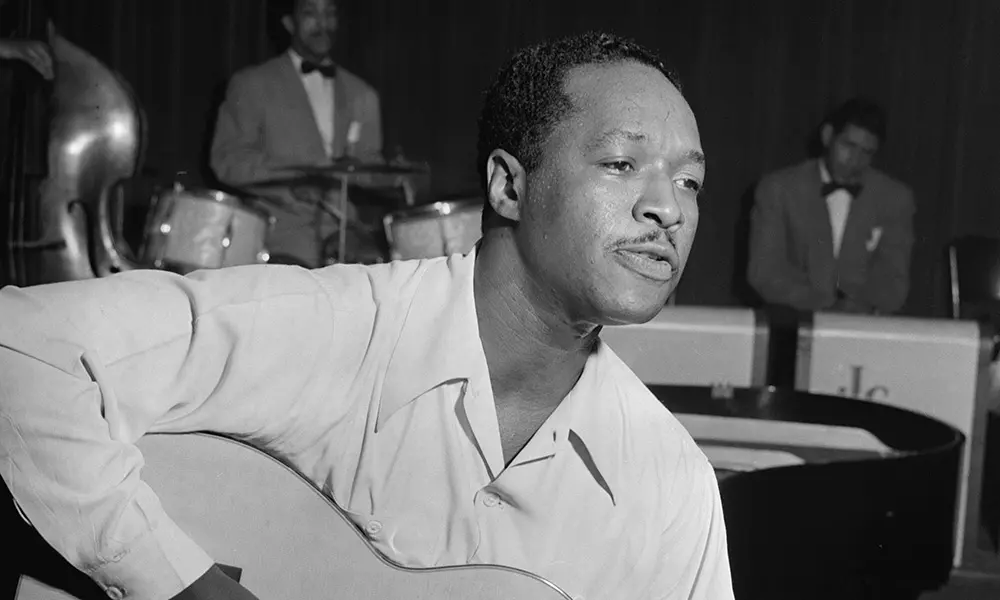
Equally at home performing Folk, Country, Jazz, or Blues, Josh White was a terrific singer, accomplished guitarist, and a songwriter to rival Lead Belly, who was one of the very best. But he was more than a musician: he was also a famous actor and a trailblazing civil rights activist, serving as a connecting bridge between fellow barrier-breaking icons Paul Robeson and Harry Belafonte.
Josh White playing his acoustic guitar.
The Song
Führer – Josh White
Genre/Style: Blues, Folk Year: Between 1941 and 1944 Length: 3:10
The Music
Structure V1-C1-V2-C2-V3-C3
The verse’s descending melodic line leads the listener down into the depths of the singer’s despair.
White’s sparse guitar arrangement offers a hint of rhythm and just a touch of harmonic texture. His chord choices (more colorful than your typical ‘cowboy chords’) belies his background in jazz.
As mentioned in the intro, the true genius of the song is in the perspective adopted by the songwriter, that is, the singer’s point of view. White has made the bold choice to give us the perspective of not an American soldier we can all root for, but a German one. From the opening lines, he puts us in the worn and frozen boots of an enemy soldier and asks us to empathize with his plight. And the remarkable thing is, he succeeds.
Title
We’ve seen the word “Fuhrer” (which translates to English as leader or guide) come up several times in this project. While there’s nothing inherently nefarious in the word itself, it’s become widely associated with Hitler, who referred to himself as “der Fuhrer,” and therefore will always carry the stain of that infamous association.
Verse 1
Tell me, my Führer / What can I do? / My hands are freezing / And my nose is blue / I’m dying of cold / But then you never can tell / ‘Cause when the Russians come / They make it hotter than hell…
Verse 1
From the very first lines, we’ve got a strong sense of atmosphere. And that atmosphere is harsh, miserable, and cold. There is no glory in this warfare, only horror and hardship.
The Chorus
I wanna go back to what’s left of Berlin / Sick of a war that I ain’t gonna win / I seen the big red star that scared the pants off the tsar / Wanna go back to Berlin
Chorus
The singer seeks the comfort and familiarity of home, or at least “what’s left” of it. Even if a return were possible, and there doesn’t seem to be much hope for this particular unnamed soldier, it would be undoubtedly bittersweet.
The red five-pointed star became the prominent symbol for the Soviet Union in the 1930s, subsequently becoming a symbol for communism around the world. And the tsar is Nicholas II, the last Russian emperor, whose dynasty ended with the Russian Revolution in 1917. This nod to pre-WWII-era Russian history shows White is a writer who’s done his homework.
Verse 2
Now listen, my Fuhrer / I’m dead on my feet / I’ve got no place for sleeping / I’ve got nothing to eat / We’ve gone and finished / All the food that we brought / And there’s nothing here for miles around / But food for thought…
Verse 2
In addition to the misery of the cold, we now add physical exhaustion and the extreme hunger that comes when rations are depleted. Still, the soldier maintains a dark sense of humor with the use of the idiom “food for thought.”
Verse 3
Now tell me, my Fuhrer / How the hell can I be brave? / I’ve got one foot in Russia / I’ve got one in the grave / I’ve got snow in my rifle / I’ve got lead in my pants / I’m so lonesome / For a touch of romance…
Verse 3
I love the specificity of “snow in my rifle;” the singer’s outlook is as bleak as his bitterly cold surroundings.
I honestly dislike the turn the lyrics take halfway through this third and final verse. This slightly raunchy attempt at humor might induce a chuckle in a different kind of song, but here it feels completely out of place.
Reflections
Josh White has been the biggest revelation of this project so far, and I will likely do a post (or series of posts) on him in the near future. There’s a reason he was included in a series of 1998 commemorative postage stamps alongside Lead Belly and Woody Guthrie. He absolutely belongs in the illustrious company of those two greats.
Today we’re discussing Track 8: ‘When the Yanks Go Marching In’ by Woody Guthrie; a simple (and infectiously singable) reworking of the traditional African-American spiritual ‘When the Saints Go Marching In.’ Frequent Woody comrades-in-musical arms Cisco Houston and Sonny Terry play and sing along.
Bob Dylan shouts out Cisco and Sonny in his ‘Song to Woody,’ (easily the best song of his 1962 debut album) including everyone on this track, plus Lead Belly, who we heard in the last track:
Here’s to Cisco and Sonny and Leadbelly too / And to all the good people that traveled with you…
Bob Dylan – ‘Song to Woody’, Verse 4 Lines 1-2
If you’re joining us for the first time, welcome! While in one way each discussion will build on the last, ultimately I’ve organized the series in a way that allows each post to stand on its own. If you have yet to listen this excellent compilation, this link will take you to my recreation of it in the form of a YouTube playlist. If you happened to give my channel a follow while you’re there, I’d be much obliged : )
If you’d prefer to start at the beginning of this series, here’s a link to the Introduction.
Right next to Lead Belly, Woody Guthrie would have to be on the Mount Rushmore of American protest singers; if you’re at all interested in American music history, folk music, protest music, or music in general, you likely know Woody.
Those who’ve been with us from the beginning will remember Woody (as an Almanac Singer) from Track 1: ‘Round and Round Hitler’s Grave,’ and Sonny Terry from Track 6: ‘Move Into Germany.’ If I’m not mistaken, this is Cisco’s first appearance on the compilation.
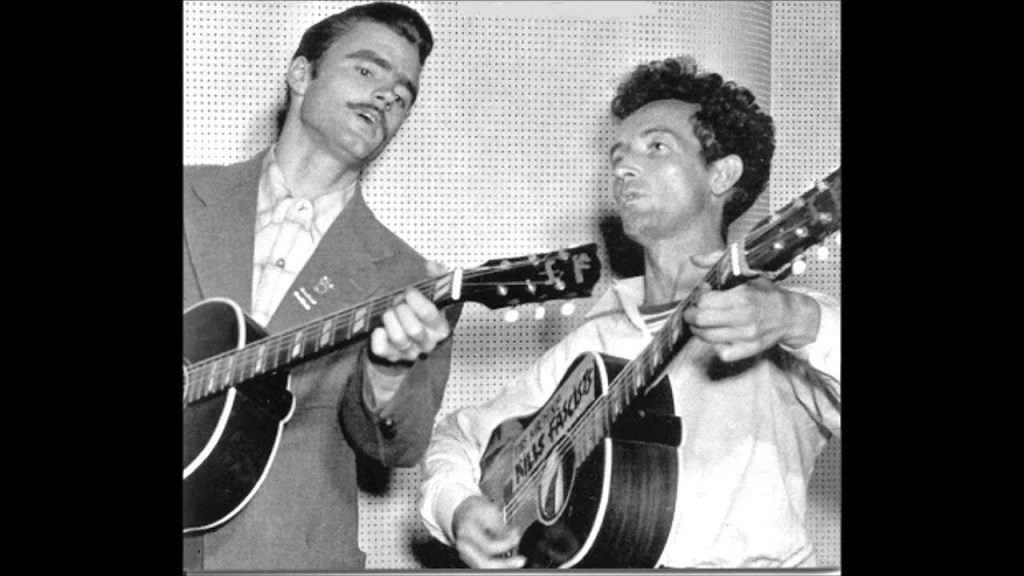
Cisco Houston and Woody Guthrie sing and strum their acoustic guitars.Sonny Terry plays his harmonica.
The Song
When the Yanks Go Marching In – Woody Guthrie
Genre/Style: Folk, Country Length: 2:46
The Music
Structure C1-V1-V2-V3-V4-C2
Chord Progression I-V7-I-IV-I-V7-I
Key C Major
The Lyrics
Many versions of “The Saints” treat it as a hymn (“O when they crown Him Lord of all…”), which makes sense considering who’s doing the marching, and its origin as a Spiritual. But there are also versions that seem entirely secular, like Louis Armstrong’s terrific 1938 recording.
Title & Chorus
Oh, when the Yanks / Go marching in / When the Yanks go marching in / Boys, I want to be in that number / When the Yanks go marching in
Chorus
Here Woody pulls a slant rhyme switcheroo, replacing “saints” with “Yanks” in the Title and Chorus. Elsewhere, he barely bothers with rhyme at all, relying almost solely on repetition to hold the lyrics together. The only other rhyme found in the song, where “tanks” rhymes with “Yanks,” seems almost unintentional.
The Chorus is only featured twice, bookending the song.
The Verses
Guns and cannons, tanks and planes: all typical wartime imagery. These common images more interesting by adding a little figurative language: the “guns and cannons” of Verse 1 don’t fire, or boom, but “roar.” And the planes of Verse 4 will “win the sky.”
Boys, I want to be in that number / When we set this whole world free
Verse 3
Reflections
‘When the Yanks Go Marching In’ isn’t necessarily a protest song, but it is an anti-fascist song. For all its similarities, I don’t think it’s as successful as Track 1: Round & Round Hitler’s Grave. More than anything, its strength lies in its simplicity, its call-and-response format allows for an instant singalong, even for folks hearing it for the first time.
If you’ve been following along, you’ll likely notice a few formatting changes in this post. This new streamlined approach will allow me to focus on the music, without getting bogged down in historical and biographical detail that is readily available elsewhere. It will also allow me to post more regularly over a greater range of topics. I’ll continue to share links that I found useful for folks wishing to dig deeper. If there’s anything essential you feel I’ve left out, let me know in the comments; I’m happy to consider your suggestions. Thanks for reading!
If you’re joining us for the first time, welcome! While in one way each discussion will build on the last, ultimately I’ve organized the series in a way that allows each post to stand on its own. If you have yet to listen this excellent compilation, this link will take you to my recreation of it in the form of a YouTube playlist. If you happened to give my channel a follow while you’re there, I’d be much obliged : )
If you’d prefer to start at the beginning of this series, here’s a link to the Introduction.
And Now…Today’s Track!
There’s a mystery at the heart of today’s tracks; one I’ve been puzzling over since I first attempted to recreate the Kickin’ Hitler’s Butt compilation on YouTube in the earliest stages of this project; one I’m hoping someone reading this can help me unravel. The question is this:
Are Track 7: ‘Hitler Song’ and Track 17: ‘Mr. Hitler’ actually the same song?
If yes, it would explain why so many sources refer to the song as both ‘Hitler Song’ and ‘Mr. Hitler;’ including Wikipedia, YouTube, and Smithsonian Folkways, who included the song in their excellent Lead Belly collection of 2015.
But if that’s true, why is the song featured twice in this compilation? If there are two versions, you’d think they’d need to be different enough to warrant the inclusion of both. And there are some clues pointing to some possible differences. Track 7 credits Josh White as a performer and, according to Apple Music, has a runtime of over 4 1/2 minutes. That adds one performer (White) and about ninety seconds to what we find for Track 17, which is credited solely to Lead Belly. So what we’d hope to find in Track 7 is an extended version of Track 17, with a clear contribution by Josh White on vocals and/or guitar.
What we find instead, or rather, don’t find…is any alternate version of Track 17 at all–at least not one we can listen to. Apple Music appears to offer a ninety-second sample of Track 7, which I was able to play, but to my ears it sounds identical to Track 17. I asked a friend who subscribes to the Apple Music to try the track, and he said it’s not actually available. I looked to Genius for help, which had an individual page for each track, but found the lyrics for “both” tracks were nearly identical.
Setting all that confusion aside–at least for now–we’re going to proceed under the assumption that these two songs are (more or less) the same song.
The Artist
Huddie Ledbetter aka Lead Belly (1888-1949)
Folk legend. Blues icon. King of the Twelve-String. Whatever you call him, Lead Belly was the living embodiment of the Great African-American Songbook, with a vast repertoire including “work songs, prison songs, ring chants, cowboy songs, games, and Tin Pan Alley to the Delta blues.” And most importantly, at least for the purposes of this blog, the First Great American Protest songwriter and singer.
The Song
Mr. Hitler (aka Hitler Song) – Lead Belly
Genre/Style: Blues/Folk Year: 1942 Written & Performed by: Lead Belly
Here are a few things to consider while listening to ‘Hitler Song’:
Is the song more folk or blues? Does the distinction matter?
How does the music conform to or deviate from what you’d expect from a standard folk or blues song?
The Music
Is it Folk? Is it Blues? Why not both? The verses are quintessential 12-bar blues, but the chorus has a singalong quality that’s more commonly found in folk songs (like Track 1: Round and Round Hitler’s Grave, for example). This transition of styles comes with another change, as the mid-tempo verses rev up to something more toe-tapping for the chorus, and then back down again in a pattern that’s repeated throughout.
The most popular tab on Ultimate Guitar has the song in D Major, with a I-IV-V7 chord progression. This is a common progression in both folk and blues music, and is sometimes referred to as a “three-chord trick.”
Rhythm and harmony for the track are provided by Stella, Lead Belly’s signature 12-string acoustic guitar. The only thing more remarkable than his playing is his voice: always passionate, powerful, and tinged with a world-weary wisdom.
When Lead Belly says, “Do that again, I did not understand you that time. Take it easy.” in the spoken intro, who exactly is he giving instructions to? If Josh White were indeed playing guitar on the track, he would be a prime suspect. But as I’ve stated above, it’s unclear what role, if any, he played in the performance of this song. Perhaps he was unhappy with his own playing, and trying to get in tune with Stella, his guitar.
Chorus
We’re gonna tear Hitler down… / We’re gonna bring him to the ground… / Someday
Chorus
The chorus is repeated four times, occurring after every verse but the last. It repeats the opening line three times, ending with “someday.” It then repeats a new line three times, with the same ending. In addition to that repetition, the two sections are tied together lyrically by the rhyme “down/ground.”
Verses
The rest of the lyrics are just as straightforward. The first two verses say more or less the same thing: Hitler has wrongfully driven the Jews from their homes.
You ain’t no iron, you ain’t no solid rock / But we American people say, “Mr. Hitler, you is got to stop!”
Verse 3
Rather than focusing on what Hitler is, or has done, here Lead Belly states what Hitler is not: He is not strong like iron. He is not solid like a rock. If he is not those things, it follows that he’s likely the opposite of those things: weak and malleable. LB then speaks for the American people as a whole with an unequivocal, emphatic “stop!”
Reflections
For me, ‘Mr. Hitler’ isn’t among Lead Belly’s best protest songs (‘Bourgeois Blues’ has it beat by a mile), even though it is one of his best known. Even coming from a man of his talent, neither the music nor the words of the track strike me as particularly poignant or even memorable.
There’s much more to say about Lead Belly’s contribution to the Great American Protest Songbook, and I plan to dig into his life and work in more detail in a series of posts in the near future. So stay tuned for that!
We’re about a third of the way through the compilation and movin’ right along! Today’s track–Track 6: ‘Move Into Germany’ by Sonny Terry & Brownie McGhee and featuring Josh White–has some of the Blues we enjoyed in our last two tracks. In addition, the fast-paced, upbeat tempo and singalong chorus give it a touch of folk akin to what we heard from the Almanac Singers on Track 1.
Let’s learn a little bit about the players before pressing play on today’s track.
If you’re joining us for the first time, welcome! While in one way each discussion will build on the last, ultimately I’ve organized the series in a way that allows each post to stand on its own. If you have yet to listen this excellent compilation, this link will take you to my recreation of it in the form of a YouTube playlist. If you happened to give my channel a follow while you’re there, I’d be much obliged : )
If you’d prefer to start at the beginning of this series, here’s a link to the Introduction.
Album CoverBack Album Cover and Track Listing
Introduction
The Artists
Sony Terry & Brownie McGhee Sonny Terry & Brownie McGhee were one of the great Blues duos in American music history. Terry’s evocative harmonica playing (and occasional whoops and hollers) provided a lively accompaniment to Brownie’s rhythmic acoustic guitar and Blues vocals. Together they helped to develop a style of music, born out of the American south, which came to be known as “The Piedmont Blues.”
“Piedmont blues (also known as East Coast, or Southeastern blues) refers primarily to a guitar style, which is characterized by a fingerpicking approach in which a regular, alternating thumb bass string rhythmic pattern. supports a syncopated melody using the treble strings generally picked with the fore-finger, occasionally others. The result is comparable in sound to ragtime or stride piano styles. The Piedmont style is differentiated from other styles, particularly the Mississippi Delta blues, by its ragtime-based rhythms.” – Wikipedia
Josh White The addition of Josh white on harmony vocals and acoustic guitar is always a welcome one. Josh White has become a new favorite of mine while researching for this project, and we’ll be talking a lot more about him when we get to Track 9: Fuhrer.
And Now…Today’s Track!
Here are a few things to consider while listening:
Is the song more folk or blues? Does the distinction matter?
How does the music conform to or deviate from what you’d expect from a standard folk or blues song?
Can you identify the ragtime rhythm associated with the Piedmont Blues sound?
What do Sonny Terry’s harmonica and vocalizations add to the overall sound of the track?
Track 6: Move Into Germany – Sonny Terry & Brownie McGhee
Genre/Style: Blues, Folk, Country Year: 1944 Players: Sonny Terry, Brownie McGhee, Josh White
Listen to the song again while reading the lyrics and consider the following:
Are the lyrics specific or general?
Are there lines or phrases you’ve heard in other songs?
The Song: Overview
Brownie McGhee is given songwriting credit for this 12-bar Blues track.
Title The title offers both a setting and a subject for the song and is well-represented, being repeated throughout the lyrics.
The Music Sonny Terry’s lively harmonica introduces the song, quickly followed by Brownie’s rhythm guitar. Brownie sings the verses, and is joined by Josh White singing backup on the chorus. White also does some soloing on his own guitar.
The Words The song makes frequent use of what in songwriting terms is known as a floating lyric: a line or pair of lines that can easily be inserted into any song to set up a rhyme.
Verse 1
I wrote Hitler a letter, this is how it read / Won’t be long we make up your dying bed
Verse 1
The song opens with a floating lyric, setting up the rhyme “read/bed.”
The “dying bed” phrase is likely a reference to the 1920s gospel Blues song ‘In My Time of Dying’ aka ‘Jesus Make Up My Dying Bed’ by Blind Willie Johnson. Bob Dylan covers the song on his debut album, which is likely the first place I encountered it.
Chorus
We’re gonna move into Germany, sure you know / We’re gonna move into Germany, won’t be long / We’re gonna move into Germany, change this old world around
Chorus
Brownie McGhee and Josh White sing together on the chorus, each line beginning with the refrain (which is also the title). This tried and true songwriting technique uses repetition to create a song that is both cohesive and memorable.
Verse 2
You can phone Harry Heath, he’s down in Tokyo…you meet, down you go
Verse 2
Who is Harry Heath and what’s he doing in Tokyo? I’m afraid I do not have an answer to those two questions. Perhaps it’s a name that McGhee heard on the news or read in a newspaper as he was writing the song. Protest songs are often topical, with names and events pulled directly from the headlines, so this is my best guess.
There are a few instances in this recording where the audio quality fails and the lyrics become unintelligible. If you’re able to make out any of the missing lyrics, please let me know and I will add them to the song page on Genius.
Verse 3
Hitler didn’t like our peaches, he shook our tree / Sunk our ships out on the sea
Verse 3
“Hitler didn’t like our peaches” is kind of a funny line. Working a floating lyric into a topical song doesn’t always go seamlessly.
Verse 4
I’ve got myself a bulldog, set of two greyhounds / Gonna use my dogs to throw Hitler down
Verse 4
Another floating lyric. This time they’re siccing the dogs on Hitler. As a lover of dogs and hater of fascists, I wholeheartedly approve.
Verse 5
You can tell old Hitler put out his dying call / Thinking blood is wine, the way to hell he goes
Verse 5
The symbolism is clearly Christian, but I’m a little unclear on what the the first half of the verse is trying to say. Maybe the songwriter is calling Hitler blood-thirsty and drunk with power. The “to hell he goes” part is pretty straightforward, though.
Verse 6
It takes a rocking chair to rock, rubber to roll / … to satisfy Hitler’s soul
Verse 6
This final verse features an inconvenient combination of floating lyrics and indecipherable vocals. I’m sure the phrase “satisfy [blank’s] soul” is older than even this 1944 song, but when I hear it I always think of Tom Waits’ song ‘Chocolate Jesus,’ from his 1999 album Mule Variations.
Reflections
While ‘Move Into Germany’ isn’t the most memorable of the tracks, it’s an easy listen, and I was happy to learn more about one of Blues’ greatest duos: Terry and McGhee. And my interest in and appreciation for Josh White continues to grow.
While Tracks 2 & 3 focused on Southern gospel vocal groups, today’s tracks feature two fine examples of Chicago Blues. Wikipedia offers some insight into the history of this particular Blues style:
Chicago blues evolved from rural Delta blues following the Great Migration, or the Great Northern Drive, which was both forced and voluntary at times, of African Americans from the southern U.S. to the industrial cities of the north, such as Chicago. Big Bill Broonzy and Muddy Waters directly joined that migration, like many others, escaping the harsher southern Jim Crow laws and in search of better jobs and a more promising life in the North.
First up, We’ll be exploring Track 4: ‘War Time Blues’ by Jazz Gillum.
Next, we’ll discuss Track 5: ‘Hitler Blues’ by Florida Kid.
If you’re joining us for the first time, welcome! While in one way each discussion will build on the last, ultimately I’ve organized the series in a way that allows each post to stand on its own. If you have yet to listen this excellent compilation, this link will take you to my recreation of it in the form of a YouTube playlist. If you happened to give my channel a follow while you’re there, I’d be much obliged : )
If you’d prefer to start at the beginning of this series, here’s a link to the Introduction.
Album CoverBack Album Cover and Track Listing
And Now…’War Time Blues’
The A-side label for ‘War Time Blues’The B-side label for ‘One Letter Home’
The Release This song, along with it’s B-side ‘One Letter Home,’ was recorded in Chicago on December 5, 1941 for Bluebird Records, a subsidiary of RCA Victor. The record was released about a month later.
The Players Session players are listed as: Jazz Gillum – Vocals, Harmonica Horace Malcolm – Piano Big Bill Broonzy – Guitar Alfred Ekins or Al Collins – Bass
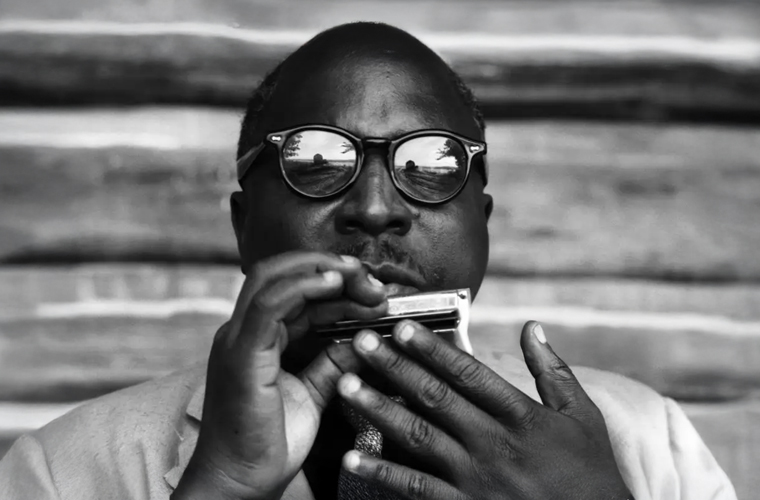
Promotional photo of Jazz Gillum for Bluebird Records
Jazz Gillum Though singer and harmonica player William McKinley Gillum (1902-1966) hailed from Mississippi, he made his name in Chicago Blues scene, where he was known as “Jazz” Gillum.
He got his start in music playing on the streets of Charleston for tips, supporting himself with music and odd jobs after running away from home at the age of seven. He moved to Chicago in his early twenties, and the change in location came with a change in fortune, as his career began to take off after hooking up with singer, songwriter, and guitarist Big Bill Broonzy, who was older and already established in the Chicago music scene as a regular contributor at Bluebird Records. He first joined Broonzy on the stage, as part of a two-man act, and then later at Bluebird, where he became known for his role in many popular “Bluebird beat” recordings of the 30s and 40s.
Not long after recording ‘War Time Blues,’ he took a three-year hiatus from music, joining the US Army. His service ended with the war in 1945.
Notable Career highlights include: – 1938: Recorded one of the earliest Blues songs to feature an electric guitar accompaniment, ‘Reefer Headed Woman,’ with jazz guitarist George Barnes.
– 1940: Recorded the Blues standard ‘Key to the Highway,’ giving the song its now-standard melody and arrangement as an eight-bar (rather than a twelve-bar) Blues.
– 1961: Recorded on albums with Memphis Slim and Arbee Stidham.
The Songwriter
Who wrote ‘War Time Blues’? Depends on who you ask!
The label for the Bluebird single credits Gillum for the song, and it would be simplest to leave it at that. However, Apple Music gives Sonny Boy Williamson I songwriting credit. He did put out a song, also on Bluebird (adding to the confusion) called ‘War Time Blues,’ recorded in May of 1940. But this version, despite having the same name, has no lyrics in common with Gillum’s. The lyrics do share many similarities with the Doctor Clayton song ’41 Blues,’ which was released in January of 1941, almost a full year before Gillum’s recording. It’s likely that Gillum’s track was adapted from both of those previous ones.
War is raging in Europe / On water, land, and in the air / If Uncle Sammy don’t be careful / We’ll all be back over there
Verse 1
Uncle Sam (or “Sammy”) makes an appearance in Verses 1 & 5 as, of course, the US government personified, or more specifically as a mascot for the military. Rather than beating the war-drum in a demonstration of blind nationalism, the singer advises caution. It’s very possible he would rather like to avoid going to war at all (a fate that was unavoidable in the singer’s own life).
Samuel L. Jackson as Uncle Sam in Kendrick Lamar’s Super Bowl LIX Halftime Show in 2025.
Verse 2
The whole world is uneven / From the king to the heathen slave / ‘Cause ol’ Hitler and Mussolini is sendin’ millions to their lonely graves
Verse 2
Here the song touches on social issues beyond the threat of war, such as social inequality. It’s also notable that here we have the first mention of slavery on an album that features a large number of Black performers.
Verse 3 & 4
The songwriter shares the first of a series of ill-wishes for both Hitler and Mussolini. He’d rather see Hitler’s head chopped off and be done with it. The next best thing would be a rapidly-spreading (“galloping”) tuberculosis. And, for Mussolini, cardiac arrest with a side of insanity.
Verse 5
This war would soon be over, if Uncle Sam would use my plan / Let me sneak in Hitler’s bedroom with my razor in my hand
Verse 5
Like in Verse 1, the singer offers some strategic advice to the US military, offering to quite literally take matters into his own hands.
Let’s keep the record spinnin’ with the next track: Hitler Blues by the Florida Kid
The Florida Kid
In all the worldwide web, there’s sadly just not much information available on The Florida Kid.
A 2025 Facebook post by Mojohand.com, which describes itself as “The One Man Blues Boutique,” offers this brief bio:
“The Florida Kid” was the recording alias of a little-known blues singer and pianist named Ernest Blunt…remembered primarily for a striking and topical song called “Hitler Blues,” recorded in 1940 in Chicago.
Beyond that single release, very little is known about Ernest Blunt. No substantial biographical details or additional recordings have surfaced under his name or alias. He stands as a mysterious figure in blues history—one of many regional musicians who briefly entered the studio, captured a moment in time, and then disappeared from the public record. “The Florida Kid” remains a fascinating footnote in the story of American blues.”
The Release
Recorded in 1940, this is the earliest track we’ve encountered so far.
Track 5: Hitler Blues – The Florida Kid
Genre/Style: Blues, Chicago Blues Year: 1940 Players: The Florida Kid
This song takes a personal, rather than historical or political approach, with Hitler acting almost like a bogeyman looming in the shadows, waiting to strike when you least expect it.
Well, baby, have you heard about Hitler? / Honey do you care? / May be on the way to our country / May heavy-hit us here
Verse 1
The singer is a man addressing a woman. He starts out sweetly, calling her endearing names like “baby” and “honey.”
Because old Hitler, he’s a bad man / Trying to take every country he know / Well, before he take this country, woman / Please be my so-and-so
Chorus
He also uses the impending threat of war as a way to try to get laid. This made me chuckle, bringing to mind the “You don’t want to die a virgin, do you?” line from the movie Independence Day (1996).
Still, there’s something kind of cute about his plea for the woman to “Please be my so-and-so.” He gets a little more forceful in Verse 2, repeatedly demanding to be brought “plenty lovin’,” which is admittedly less cute.
Well, Hitler say he was a man / From his feet to his chest / He don’t bar nobody but / God and Death
Verse 3
There’s almost a sense of admiration for Hitler’s toughness in Verse 3. The phrase “don’t bar nobody” I take to mean something like he doesn’t concern himself with the opinions of, or take any shit from, any living human being.
Hitler got his just-right tanks / His planes and ships / He get over your town / He’ll let his big bomb slip
Verse 4
The final line of Verse 4 hints at a possible euphemism in the same vein as Outkast’s ‘Bombs Over Baghdad.’
Hitler says some of our peoples are white / Says some are brown and black / But Hitler say all Americans to him / Look just alike
Verse 5
While the previous track is the first to mention slavery, this is the first mention of race in the album. There’s obviously a lot to be said on both topics, but I’ll leave those large reflections for a later date.
Well, you better mind how you get drunk / Be careful how you clown / You may wake up one of these mornings / And Hitler be wreckin’ your town
Verse 6
The song ends with some closing words of caution. I appreciate that his message is not to stop getting drunk and clowning—The Kid is no buzzkill. He just asks his countrymen to be a little more mindful in how they go about their intoxicated buffoonery.
Today we’re discussing Track 3: ‘Praise the Lord & Pass the Ammunition,’ a song that shares many similarities with our last track, ‘Stalin Wasn’t Stallin’.’ In fact, one of the early members of the Golden Gate Quartet, William Langford, left that group to form a new one, which he called…you guessed it, the Southern Sons!
Other similarities include:
All-male, all-Black gospel vocal group from the Southern US.
Formed in the 30s and is still active today, but with an ever-changing lineup of vocalists.
Features at least one section where the primary lyrics are spoken, or more specifically, sermonized.
Lyrics feature clever wordplay.
There are also a few key differences:
Unlike our previous track, this song wasn’t written by one of its members, but by acclaimed songwriter Frank Loesser, who we’ll discuss later.
The group is a quintet rather than a quartet, featuring a fifth member, a second baritone.
While the recording is technically “unaccompanied,” there are sound effects interspersed throughout.
If you’re joining us for the first time, welcome! While in one way each discussion will build on the last, ultimately I’ve organized the series in a way that allows each post to stand on its own. If you have yet to listen to the album, this link will take you to my recreation of it in the form of a YouTube playlist. If you happened to give my channel a follow while you’re there, I’d be much obliged : )
If you’d prefer to start at the beginning of this series, here’s a link to the Introduction.
Album CoverBack Album Cover and Track Listing
Before we listen to today’s track, let’s set the stage with a little background info.
Who Were the Southern Sons?
Details about the Southern Sons are frustratingly hard to come by. We learned in our post for Track 2 that William Langford, tenor and founder of the group, left the Golden Gate Quartet sometime between 1938 and 1940. His motivations for doing so are not clear, but, interestingly, he chose to create not another quartet, which was the standard form of this type of vocal group at the time, but a five-piece quintet.
Here’s my best guess at the line-up at the time today’s track was recorded:
Tenors: William Langford, Kissler James Baxter Baritones: Wesley Hall, Howard Wilson Bass: Clifford Givens
I say ‘best guess’ because personnel records for individual recording sessions are inconsistent. We know that today’s track was recorded in October of 1942 in New York for Bluebird, a subsidiary of RCA Victor. But we don’t have a personnel record for that particular session. What we do have is a personnel record of a session from August of that year, and we’re going to have to assume there were no line-up changes for the group in the two months between that session and the one that produced today’s track, along with its B-side, ‘Lift Every Voice and Sing.’
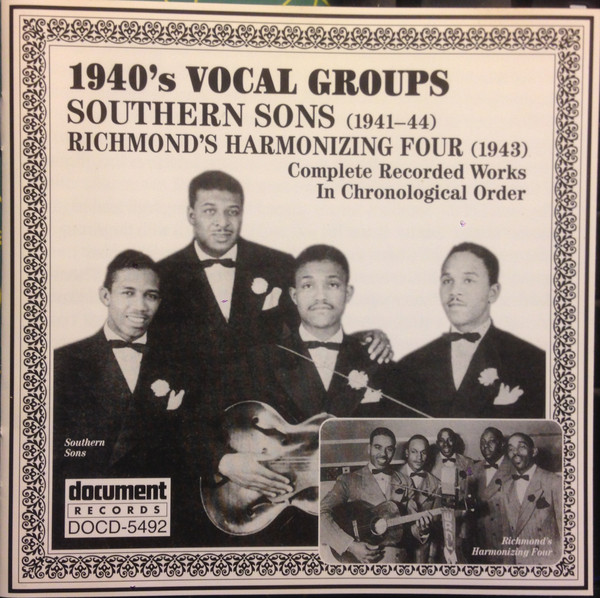
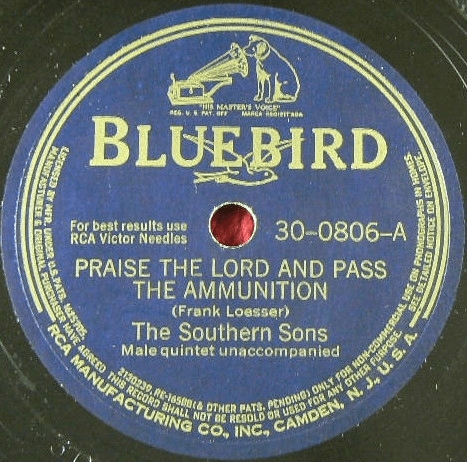
Album cover image featuring four members of the Southern SonsA-side label for ‘Praise the Lord and Pass the Ammunition’ pressed by Bluebird/RCA
The Songwriter
New York City songwriter Frank Loesser was both prolific and highly decorated. In addition to providing songs for over sixty Hollywood films, he wrote the music and lyrics for the Broadway musical juggernaut Guys and Dolls, which earned him a Tony Award. Outdoing himself, he was awarded a Pulitzer Prize for Drama for How to Succeed in Business Without Really Trying, and later an Academy Award for the holiday staple ‘Baby, It’s Cold Outside.’ It’s not an EGOT, but it’s arguably just as impressive.
The Release
The song was first published as sheet music in 1942 and quickly became a best seller. Although the song was a relative hit for the Southern Sons, their version was not the most popular, and the group itself didn’t enjoy the same success as even The Golden Gate Quartet. Though the song has a Wikipedia page, the Southern Sons do not. In fact, they’re not mentioned in that article. The most popular version of the song was by Kay Kyser and His Orchestra, which was released at about the same time.
Legacy
If the title phrase (but not the song itself) sounds familiar, you likely have Serj Tankien of the alt-metal band System of a Down to thank for that. His 2007 protest song from the album Elect the Dead is a very different take on the theme suggested by the title. You can read the full lyrics of his version here. Serj and System play an important role in the evolution of protest music, particularly in the early aughts, so we’ll discuss them in more detail in the future.
And Now…Today’s Track!
Track 3: Praise the Lord & Pass the Ammunition – The Southern Sons Quartet
Genre/Style: Vocal (Male), Gospel, Patriotic Song by: Frank Loesser Year: 1942 Length: 3:12 Singers: Kissler James Baxter, William Langford, Wesley Hall, Howard Wilson, Clifford Givens
Note that this structure, with two bridges and and extended outro, is fairly unusual. And I’m not sure this format favorably impacts the trajectory of the song, particularly in the second half. I’ll discuss this more in the Outro section of this post.
Music
While there are no instruments in this recording, the first thing you hear are not vocals, but sound effects, which make the production unique. I’m unsure if these sound clips are from real-life military air battles, or were made in a studio for entertainment purposes, though I suspect the latter.
Compared to Track 2, this song is more playful with its vocal arrangement. In particular, Cliff Givens’ bum-pum-bumming bassline gives the song bounce and propulsion. Hand claps lend additional rhythmic texture.
Lyrics
Story
Of the songs we’ve covered so far, the lyrics for this one tell the strongest story. Right away, we’re introduced to characters (the Gunners and the Sky Pilot), and we know exactly where they are (in a plane) and what’s happening to them (getting shot up in a dogfight).
If you’re interested in learning more about what it was like to be a gunner in a WWII bomber, this article that describes the experience in detail, told by someone who was in the hot seat himself.
In the article “The Life of a Ball Turret Gunner” journalist Bob Podurgiel describes the experience of Santo Magliocca, who had “one of the loneliest jobs imaginable – Ball Turret Gunner on a B-24 bomber, flying missions over Nazi-occupied Europe.”
Santo flew 23 combat missions with the 451st Bombardment Group, 15th Air Force out of Foggia, Italy. His job was to hang alone, suspended underneath the bomber in a rotating bubble where he manned twin .50-caliber machine guns.
The Plexiglass and aluminum sphere was only 3.5 feet in diameter, large enough to fit a small man curled up on his back almost in a fetal position.
The guns’ barrels were positioned between the gunner’s feet and the hydraulic motors that rotated the sphere were by his head.
The ball turret gunner could actually spin his turret 360 degrees, as well as up-and-down to a 90 degree angle from the ground.
Designed to protect the bomber from German fighter attacks below, the turret was so cramped the gunner couldn’t wear a parachute.
If the B-24 took a direct hit from enemy flak, sending the plane into a death spiral, Santo, like all Ball Turret Gunners, had to crawl back into the plane’s fuselage before he could put on a parachute to bail out.
Wordplay
Rhyme Time
Verse 1, with its AABB rhyme pattern, varies slightly from the other verses.
The other sections feature rhymes that play off of the Chorus:
From “Lord” we get “afford” (V2) and “aboard” (V3).
From “Ammunition” we get “position/wishin/perdition” (V2) and “mission/fishin'” (V3).
From “Free” we get “sea” (V2), and “he” (Bridge).
Anatomy of a Song
The Title
This seems to be a song born out of a title, with a title born out of legend. I don’t believe songwriter Frank Loesser claims any authorship of it. If the title quote originated from a clergyman at all, it was most definitely not from one in a plane. The more plausible account, offered in the Wikipedia song page, place the “sky pilot” aboard a warship, such as the USS New Orleans, during the attack on Pearl Harbor.
Regardless of who said it (and where), let’s explore the phrase to see if we can figure out what makes it so catchy:
1. Meter. The line is written in perfect dactyllic meter, with a strong (or stressed) syllable, also called a beat, followed by an unstressed, or weak one. This is written / u. Alternatively, strong beats are sometimes written in all caps: PRAISE the LORD and PASS…etc. You may be familiar with dactyllic’s mirror image, the iambic, written u /, which was a favorite of Shakespeare and other poets of his era. This meter is carried through much of the song.
2. Alliteration & Consonance. There is clear repetition of the “P” sound in the words “praise” and “pass,” and both fall on a strong beat. Those two words also end in an “S” sound, but since those are at the end of the word and not the beginning, that repetition counts as consonance, rather than alliteration. Similar techniques can be found throughout the rest of the song.
3. Contrast & Misdirection. The second action does not seem to follow directly from the first. If you were to read the fragment “Praise the Lord and—” you would likely expect it to continue along the same lines; something religious, probably taking place in a church. Instead, we get an unexpected shift. We are suddenly at war, with bullets whizzing by our heads.
Verse 1
Down went the gunner / A bullet was his fate / Down went the gunner / And then the gunner’s mate…
Verse 1, Lines 1-2
The first verse starts us right in the middle of the action. We’re in a deadly dogfight and the gunners themselves are getting gunned down left and right.
When I first read the term “sky pilot,” I assumed the song was referring to an actual pilot, the aviator of the aircraft. And it seemed unlikely that even the most devout pilot would be reading a book (even “the Book,” aka the Bible) during an active air battle.
With a little research, I learned the epithet “Sky Pilot” did not describe a pilot at all, but a clergyperson, or chaplain. Interestingly, Eric Burdon and the Animals released a song about a military chaplain called ‘Sky Pilot’ in 1968. Unlike the title character in this song, Burdon’s “Sky Pilot” was anything but a heroic figure.
The Chorus
The Chorus is repeated three times throughout the song without variation of lyrics or music.
Praise the Lord and pass the ammunition…And we’ll all stay free
Chorus
The Chorus features a simple repetition of the title three times, followed by the phrase “And we’ll all stay free. This final line could be tacked onto the end of about any patriotic refrain, and is admittedly a tad generic.
Bridge
Yes, the sky pilot said it / You gotta give him credit / For a son-of-a-gun of a gunner was he
Bridge
The propulsive rhythm of the lines ‘sun-of-a-gun of a gunner’ could be a playful way to echo the rat-a-tat-tat-tat of machine gun fire.
Outro
Tenor James Baxter delivers the closing outro, or rather, sermon, repeating the lyrics from earlier sections of the song in an elevated spoken style. While this change adds an element of variety to the song, I’m afraid, at least for me, this is where the track loses momentum, ultimately coasting into the finale on little more than fumes.
Reflections
For all its strengths, the themes of the song could be viewed as problematic from a modern perspective in several ways:
Guns & God. The title phrase is one that seems bound to be co-opted by the…other…kind of patriot. I can imagine it stuck to the bumper of a flag-waving pick-up truck as it belches black smoke from oversized exhaust pipes. These are the same folks who believe “thoughts and prayers” to be a sufficient response to the mass-shootings that all too frequently terrorize US schools and other public spaces.
Glorification of Violence. The story told in the song highlights the danger and excitement of an air battle, but does not reflect upon the loss of life (the two gunners) even a little.
Jingoism. Jingoism, or extreme nationalism, is a far cry from the freedom-loving patriotism which it pretends to be. And elements of this song, along with several other songs on this compilation, could justifiably be seen as falling on the wrong side of the jingoism/patriotism divide.
With God on Our Side?
I’ll leave you with the final lines of Bob Dylan’s 1963 anti-war masterpiece, ‘With God On Our Side’:
The words fill my head / And fall to the floor / If God’s on our side / He’ll stop the next war
Today we’re discussing Track 2: ‘Stalin Wasn’t Stallin” by The Golden Gate Quartet. This is the first of three Black male A capella group performances featured on this album, and it will be interesting to compare their contributions as we progress through the series.
As you can tell by the punny title, today’s song approaches its subject—the role of Russia and its leader, Joseph Stalin, in helping the Allies to beat back Hitler’s advancing army—with more than a little bit of humor.
You’ll notice right away that the performance style is very much of its time. And while the quality of the recording is admittedly less than stellar, that doesn’t have to keep us from enjoying the song for what it is, and what it can tell us about the history of recorded music in America.
If you’re joining us for the first time, welcome! While in one way each discussion will build on the last, ultimately I’ve organized the series in a way that allows each post to stand on its own. If you have yet to listen this delightful compilation, this link will take you to my recreation of it in the form of a YouTube playlist. If you happened to give my channel a follow while you’re there, I’d be much obliged : )
If you’d prefer to start at the beginning of this series, here’s a link to the Introduction.
Album CoverBack Album Cover and Track Listing
Before we get into the music, let’s learn a little about the people involved.
The Golden Gate Quartet According to one source, it all started in a barbershop—a fitting beginning for any quartet—in Norfolk, Virginia. It was there, in 1934, that a one-legged bass vocalist by the name of Robert “Peg” Ford and tenor singer A.C. “Eddie” Griffin (the owner of said barbershop) decided to create an all-male four-piece A capella group that would specialize in the style of gospel singing known as “jubilee.”
Unlike, say, the older Alabama gospel tradition, with its trademark reliance on formal song structure and straight-ahead harmonies, Virginia’s gospel music was looser, and more rhythmic. Influenced by such varying sources as the pop group Mills Brothers, the swinging jazz of the Three Keys, and the emotional wailing of area pulpit preachers, jubilee singing was something daring and exciting – gospel music geared for the body as well as the soul. – interjazz.com
Knowing their group needed a spark of youthful energy, they visited the local high school, Booker T. Washington, and recruited two young singers from the glee club: second tenor Henry Owens and baritone Willie (sometimes spelled Willy) Johnson.
A short time later, Peg and Eddie were replaced by two more students: William Langford (first tenor) and Orlandus Wilson (bass). It was these four young Black singers who began performing, first in churches and later on local radio, as The Golden Gate Jubilee Quartet.
And they had quite a bit of success. In 1938 alone, they performed in John Hammond’s historic From Spirituals to Swing concert at Carnegie Hall, and released two of their most popular records: the spiritual ‘John the Revelator,’ which would later be inducted into the National Recording Registry, and ‘Golden Gate Gospel Train,’ which would earn them national radio airplay and become a signature song for the group.
Two years later, they signed a new contract with Okeh, a subsidiary of Columbia Records, and officially changed their name to The Golden Gate Quartet. It’s around this time that Willian Langford left the group and was replaced by Clyde Riddick. This would usher in a new era of departures and replacements for the group.
The Quartet made history again in 1941, as the first Black musical group to sing at Constitution Hall, after being invited to perform at the inauguration of Franklin D. Roosevelt.
Ninety (yes, NINETY) years later, the group remains active. Its longest-standing member, Orlandus Wilson, was active in the group for sixty-three years, from 1934 to 1998. He joined at the tender age of 16, though he did miss one year, 1944…but you can’t blame a guy for getting drafted. In addition to being a talented bass vocalist, Wilson was active in arranging and composing for the group. Of the four founding members, only Wilson has his own Wikipedia page.
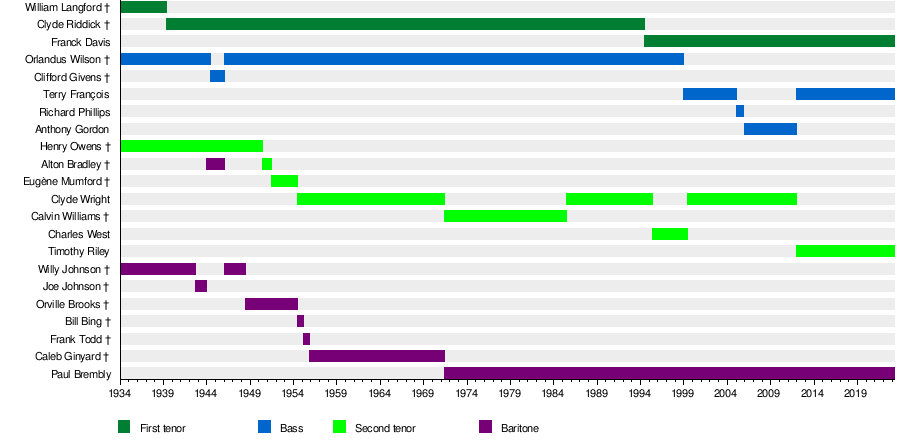
If you’re interested in knowing more about the group’s many members, here’s a timeline from Wikipedia
Keeping this brief bio in mind, let’s listen to today’s track!
Track 2: Stalin Wasn’t Stallin’ – Golden Gate Quartet
Genre/Style: Vocal (Male), A capella Song by: Willie Johnson Year: 1943 Singers: Willie Johnson, Henry Owens, Orlandus Wilson, Clyde Riddick
Stalin wasn’t stallin’ / When he told the beast of Berlin / That they’d never rest contented / Till they had driven him from the land
The Songwriter Willie Johnson, it turns out, is a common name among musicians of the time. Early Blues enthusiasts will have heard of the gospel Blues singer and guitarist, ‘Blind’ Willie Johnson. Electric Blues fans may know the guitarist Willie Johnson, famous for his work with Blues legend Howlin’ Wolf. I had to do some digging, but finally found the Willie Johnson I was looking for: Bill ‘Willie’ Johnson, songwriter, baritone, and original member of the Golden Gate Quartet. Unfortunately, there’s no Wikipedia page for Willie, and further information is hard to come by.
Structure C1-V1-V2-V3-C2-V4-V5-C3-V6-C4
The Title A pun in a title sets a tone—it says, “we’re having fun with it” at its best, and “aren’t we clever?” at its worst. There is definitely a fine line between the two. With a title like ‘Stalin Wasn’t Stallin’,’ I think we’ve got to take the humor that the wordplay suggests as intentional. Whether or not the humor is successful is mostly up to the listener.
The Chorus Since the chorus, which begins the song, is repeated four times, with little to no variation, we’ll touch on it here before moving on to the verses. We’ll make a quick note of the music, but the thing that really stands out here is that wordplay.
Stalin wasn’t stallin’ When he told the beast of Berlin That they’d never rest contented Till they had driven him from the land So he called the Yanks and English And proceeded to extinguish The Führer and his vermin This is how it all began
Full Chorus
Music The Chorus is sung in four-part harmony with a punchy, staccato delivery that’s more jazz than gospel.
Wordplay Once again, the lyrics draw some attention to themselves through wordplay. The chorus alone features rhyme (Berlin/vermin, English/extinguish, land/began), including one homonym (Stalin/Stallin’); alliteration (beast of Berlin); and assonance (proceeded/extinguish). The phrase “beast of Berlin” seems to be a play on the idiom “beast of burden.” Though I don’t think it qualifies as a pun, it’s still a clever trick of misdirection.
The Verses The six verses are delivered by baritone songwriter Willie Johnson in a spoken-word style resembling a sermon, which fits especially well given the group’s gospel background.
Each verse features an xAxAxBxB rhyme scheme.
Verses 1-3
Now, the Devil, he was reading / In the Good Book, one day / How the Lord created Adam / To walk the righteous way…
Verse 1, Lines 1-4
The first three Verses are sung back-to-back, so we’ll discuss them both now.
Here, some familiar characters are introduced. First, we have the Devil, and he’s doing something unexpected: reading the Bible (presumably for the first time). More specifically, he’s reading the Book of Genesis, and taking particular issue with the story of the Lord’s creation of Adam—a man divinely designed “to walk the righteous way.” Fueled by jealousy, he sets out to create not an anti-Christ, but an anti-Adam.
While Adam is formed out of dust, Hitler (the Devil’s Evil Adam) is laid rather like an egg: “Then he mixed his lies and hatred / With fire and brimstone / Then the Devil sat upon it / That’s how Adolf was born.”
So he packed two suitcases / Full of grief and misery / And he caught the Midnight Special / Going down in Germany…
Verse 2, Lines 1-4
I appreciate the shoutout to the blues standard ‘Midnight Special,’ first recorded in 1926 as “Pistol Pete’s Midnight Special” by Dave “Pistol Pete” Cutrell.
Now Adolf got the notion / That he was the master race / And he swore he’d bring New Order / And put mankind in its place…
Verse 3, Lines 1-4
The New Order embodied the Nazi vision of a pan-German racial state structured to benefit an alleged Aryan-Nordic master race. It outlined the German colonization of Central and Eastern Europe, alongside the Holocaust against Jews and wider destruction of Romani people and others deemed “unworthy of life”. The plan also entailed the extermination, expulsion, or enslavement of most Slavic peoples and others classified as Untermenschen (subhumans). Nazi Germany’s aggressive pursuit of this territorial expansion (Lebensraum) was a primary cause of World War II. – Wikipedia
Then that bear smacked the Führer / With a mighty armored paw / And Adolf broke all records / Running backwards to Kraków…
Verse 5, Lines 1-4
The Russian Bear is a widespread symbol (generally of a Eurasian brown bear) for Russia, used in cartoons, articles, and dramatic plays since as early as the 16th century, and relating alike to the Russian Empire, the Russian Provisional Government and Russian Republic, the Soviet Union, and the present-day Russian Federation.
The uses of the bear are mixed. It was often used by Westerners, in British caricatures and later also used in the United States, often not in a positive context. On occasion it was used to imply that Russia is “big, brutal and clumsy”. However, Russians have also used it to represent their country, where it has been used as a “symbol of national pride. – Wikipedia
Then this bear called on his buddy / The noble fightin’ Yank / And they sent the Führer running / With their ships and planes and tanks…
Verse 6, Lines 1-4
After the Japanese bombing of Pearl Harbor in December, 1941, the United States declared war on Japan. Germany and Italy declared war on the U.S. a few days later, and the nation became fully engaged in the Second World War.
U.S. involvement in the Second World War was quickly followed by a massive mobilization effort. With millions of men and women serving overseas in the nation’s armed forces, most of those who remained at home dedicated themselves to supporting the war effort in whatever means was available to them. Women, who had worked as homemakers or had held jobs outside military-related industries, took jobs in aircraft manufacturing plants, munitions plants, military uniform production factories, and so on. – Library of Congress
Many see Hitler’s attack on (and eventual retreat from) Russia to be the major turning point in the war. As a major cause for celebration for the Allies, the event is mentioned in the majority of the tracks on this album, most of which were written shortly after this retreat in June of 1941.
Final Lines
Now the Führer’s having nightmares / ‘Cause the Führer knows darn well / That the Devil’s done wrote “Welcome” / On hs residence in Hell
Verse 6, Final Lines
Reflections
But Wait…I Thought Stalin was a Bad Guy
It’s ok (and often necessary) to acknowledge when a song hasn’t aged well. Today, Joseph Stalin is viewed as a tyrant whose regime was guilty of innumerable crimes against humanity, including mass deportation, starvation, and genocide. So it’s a bit of a shock to hear a song that appears to praise both Stalin and Russian might. But one must remember, this was a time before the Cold War’s threat of Russian nukes, and that at the beginning of WWII, many—including Winston Churchill and President Roosevelt—believed Stalin’s Russia was a necessary ally in defeating Hitler. As the war ended, Stalin’s popularity quickly began to wane, and his reputation would take a severe blow with the publication of George Orwell’s Animal Farm (1945).
It wasn’t until the dissolution of the Soviet Union in 1991, when many archival materials became declassified, that historians began to get a clear picture of the number of people killed by Stalin’s regime: a number in excess of three million.
Song about a Song One of the great songs that opens with, “I’m writing a song…”
More Than Your Average Rhyme Scheme – End Rhymes: Verse lines 2 & 4 (tears/year), Chorus lines 1 & 2 (star/are). – Internal Rhymes: Verse & Chorus line 3 (fear it/hear it, say it/play it).
Funny Features some great lines of self-deprecating humor, such as, “It’s a good thing that I’m not a star.”
Strong Title/Refrain Relationship The repetition of the refrain at the end of both verse and chorus makes the whole song more cohesive.
1-2-3, 1-2-3 I love a waltz. Many of my favorite songs are in 3/4 time.
Nice and Easy The song is leisurely-paced, which makes it fun to sing along to and really milk the melody for all it’s worth.
Short and Sweet Despite its slower tempo, it manages to feel complete in just over 3 minutes.
Arrangement The simple country-style instrumentation (acoustic guitar, steel slide, piano/organ, bass) suits the song perfectly.
Chords and Keys – The simple country 3-chord trick (A-E7-D) does just what they need to do and no more. – Note the song, despite being “sad,” is in a major key, rather than a minor one.
On a Personal Note
I first encountered this song in the 90s from the album Fashion Nugget by the band Cake. It was a few years later that I discovered it was a Willie Nelson cover from the 70s. It’s one I’ve always enjoyed singing along to. It’ll likely be the first tune I look for if I ever take another crack at karaoke.
Welcome to the first of ten posts exploring this terrific collection of protest songs. Today we’ll be discussing the first track on the album, ‘Round & Round Hitler’s Grave,’ by The Almanac Singers—an anti-fascist ditty you can do-si-do to!
The Almanacs do more than dance on Hitler’s grave…they hoot, holler, whistle, and wail around it, all while picking, strumming, and singing about the many ways they’d like to bring about his untimely demise. This is a proper high-spirited hootenanny, with a real sense of joy in the performances, proving you can fight fascism and have fun at the same time.
Pete Seeger (voice, banjo) takes the lead in each of the six short verses, with the Almanacs jumping in with a lively chorus after each, and Sis Cunningham bridges the gaps with a playful accordion part.
If you missed the Introduction to this series and you want to know more about the album, you can find it here.
Album CoverBack Album Cover and Track Listing
Before we dig any deeper, let’s give the song a spin!
Genre/Style: Folk, Country Year: 1941/1942 Song by: Pete Seeger, Woodie Guthrie, Millard Lampell Players (shown below, from left to right): Woody Guthrie (guitar), Millard Lampell, Bess Hawes (guitar), Pete Seeger (banjo), Arthur Stern, Sis Cunningham (accordion)
The Almanac Singers
“In 1940…the group climbed into a midnight blue Buick and blazed a trail across the United States, spreading the gospel of unionism and bringing folk music back to the people. Creating a new kind of topical music, The Almanac Singers used old folk melodies to tell the stories of the time while planting seeds wherever they went. They played at parties, rallies, benefits, unions meetings, and informal “hootenannies”, a term Pete and Woody learned on an Almanac tour of Portland and Washington.” – Bob Wolpert (2025).
The folk Protest supergroup known as The Almanac Singers (founded by Pete Seeger, Lee Hays, and Millard Lampell) grew out of the fabled New York City folk scene of the early forties. Today, the group is best known for their 1941 recording of the trade union song, ‘Which Side Are You On?,’ written in 1931 by American activist Florence Reece.
The Almanac Singers, Pete Seeger, and Woody Guthrie will all get their share of the spotlight in future posts (Guthrie sooner than the others, as he makes another appearance on this album), so I’ll save the biographies for another time. We’re here first and foremost to dance ’round Hitler’s grave, after all.
A Little Background on the Song
“We got to sing [the pro-war song, ‘Round and Round Hitler’s Grave’] on January ’42, on a nationwide CBS broadcast, ‘This is War’. But the next day a headline in a major New York newspaper said ‘Commie Singers try to Infiltrate Radio,’ and that was the last job we got” – Pete Seeger
No Wikipedia page for the song exists; the only direct mention of it on the site seems to be from the above Pete Seeger quote from his book Where Have all the Flowers Gone?, which shares a title with one of his best-known songs.
This song is not among the group’s most popular, which is one of the reasons I dig this compilation. In fact, the recording doesn’t appear on an album until 2001, when it appeared on the Songs of Protest compilation (Prism).
The Song: Overview
Verse 1
Now I wished I had a bushel / Wished I had a peck / Wished I had old Hitler / With a rope around his neck
Verse 1
They’re literally going for the neck in this first verse. The bushel and peck lines are about as stereotypically ‘folksy’ as you can get, and seem transplanted from another song, but they set up the rhyme with neck nicely.
You’ll notice right away how quickly these verses fly by. This song is really about the Chorus.
Chorus
Hey! ‘Round, ’round Hitler’s grave / ‘Round, ’round we go / Gonna lay that poor boy down / He won’t get up no more
Chorus
I suppose songs have been going ’round and ’round ever since people started singing and dancing. Doing so around someone’s grave brings to mind the idiom to dance on someone’s grave, which has been in use since at least the 1800s.
It’s generous to call Hitler a ‘poor boy,’ I take that expression as another bushel-and-peck style folkism.
The final line completes the slant rhyme (go/more) and is satisfying in its finality.
Sometimes I like to try to tune in on each singer’s individual voice as they sing in unison, and say to myself, “There’s Woody!” or “That must be Bess!”
Verse 2
Mussolini won’t last long / Tell you the reason why / We’re gonna salt his beef / And hang it up to dry.
Verse 2
Hitler’s not the only one in the line of fire here. The Almanacs also threaten to make beef jerky out of Mussolini. Or perhaps, since he’s Italian, he’d make a better bresaola: a type of aged air-dried salted beef known for its reddish-purple color.
Verse 3
The German army general staff / I guess they missed connection / Went a hundred miles a day / But in the wrong direction
Verse 3
I don’t believe this line is referring to a literal historical event (please let me know if I’m wrong). I think they’re merely poking fun at the German army and its inept leadership. Particularly, their ill-fated decision to prematurely invade Russia.
Verse 4
I’m goin’ to Berlin / To Mister Hitler’s town / I’m gonna take my forty-four / And blow his playhouse down
Verse 4
Look out! Pete’s got a gun! If you’re picturing the jovial folksinger brandishing a .44 Magnum, I’ve got some bad news: Dirty Harry’s infamous weapon of choice wouldn’t be in production for another fifteen years.
I have the impression that the phrase “blow (the) playhouse down” has some history in song, and I did a little digging, but without much to show for my effort. There’s a song called ‘I’m Gonna Tear Your Playhouse Down,’ written by Earl Randall and recorded by Ann Peebles (of ‘I Can’t Stand the Rain’ fame), but that came much later in 1972. Gillian Welch’s ‘Tear My Stillhouse Down’ came even later, in 1996. Perhaps “playhouse” is a clever nod to the expression “theater of war,” or perhaps I’m overthinking all of this.
Verse 5
How Hitler went to Russia / In search of Russian oil / But the only oil he’ll find there / Is a pot in which he’ll boil
“Opinions may differ on the question of whether or not oil was the decisive motive for Hitler’s attack on Russia. But after ten months of the Russian campaign there can be no doubt of Hitler’s imperative need of the Caucasian oil fields…To achieve his purpose Hitler must have new oil supplies; and he must deprive the Soviet Union of hers.” – Frederick Phillip Hellin (June 1942 Issue)
The concept of an ‘oil war’ is certainly not a new one. I shouldn’t have been surprised to discover that the term even has its own Wikipedia page. As a child of the early 80s, I’ve followed the frontline news reports of one oil war after another with fascinated horror: The Iran-Iraq War (1980-1988), The Gulf War (1990-1991), The Iraq War (2003-2011), and here we are again in 2026, as if it will never stop, as if we’ll never learn.
Verse 6
Now Mister Hitler’s traveling mighty fast / But he’s on a one-way track / Started down that Moscow road / But now he’s coming back
Verse 6
Hitler tucks tail and runs in the sixth verse. Though it is the last, there’s nothing particularly final about the lines here. The feeling is more that this song could go on with any number of verses, ’round and ’round for as long as the players can keep it up, or even better, until all the fascists that plague humanity are tucked safely into their final burying ground.
Reflections
This is a protest song with a vibe miles away from Dylan’s iconic ‘Masters of War,’ with its cutting line, “I’ll stand over your grave until I’m sure that you’re dead.” And that’s part of what I like about it. Is this song among my favorites of this album? Yes. It is also among my favorites by this group, let’s say, somewhere in the Top 5. And it’s one I don’t mind getting stuck in my head.
As a performer, I probably wouldn’t cover it as-is, but I would like to try out the banjo part the next time I get my hands on one. I think you could have some fun rewriting the lyrics by either substituting in updated figures and events (a few should come immediately to mind), or generalizing in a way that says, more or less: Fuck ALL the fascists:
“Hey! ‘Round and ’round the fascist’s graves / ‘Round and ’round we go / Gonna lay the bastards down / Won’t get up no more”
Welcome back to the blog, comrades! I’m trying something new that I hope will be of interest to many of you—my first annotated playlist! This introduction is being published simultaneously with Part 1 of this 10-part series. If I’m feeling ambitious once I’ve finished, I may try to consolidate it all into a single mega-post. But for now, I’ll be posting weekly through the new few months. So be sure to check back regularly.
Due to a lack of availability, I have recreated this album as a playlist on YouTube, collecting the highest-quality videos from verified sources. All of the songs except ‘Hitler Song’—credited to Josh White and Lead Belly—are included (more on that later). For increased ease of access, I’ve linked the playlist via TuneMyMusic, which lets you stream a playlist on your platform of choice. That said, I recommend listening on YouTube, as track availability on other platforms will vary. If you happen to give my page a follow while you’re there, I’d be much obliged : )
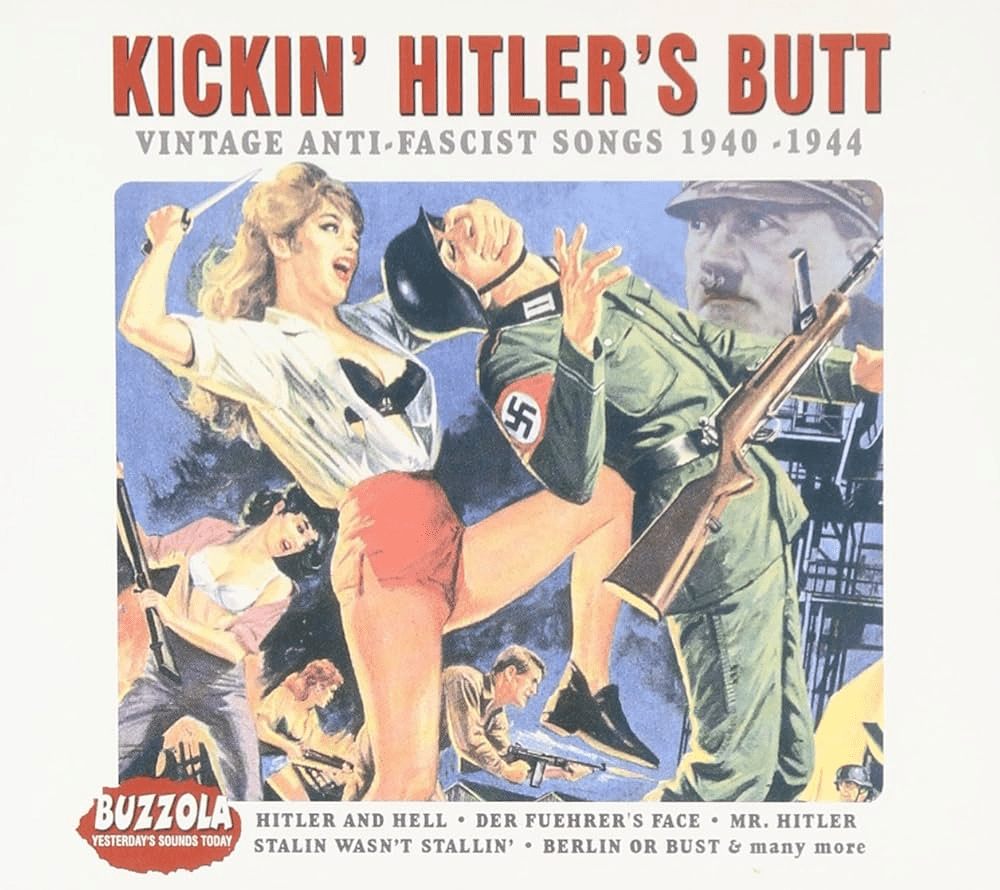
This album was released in the UK on May 13, 2007. Three companies were involved in the production, manufacturing, and distribution of the album: Buzzola, Chrome Dreams, and Gonzo Distributed. This release may have been limited, as the album is not currently widely available. I don’t currently own a copy myself, but I hope to track one down eventually and get a look at that sweet “full-colour booklet.” (PS I don’t give money to Amazon.)
Product details list the album as having a single disc, which is a little surprising. With 18 songs included, I assumed it would be a two-disc set, primarily to avoid loss of audio quality due to compression. Unfortunately, without having the physical album or even a streamable version available, I’m unable to compare the sound quality of this “remastered” release to other releases of the same recordings.
The Title
“Kickin’ Hitler’s Butt” is a fun title, right? I was surprised to see the term ‘Anti-Fascist’ in the subtitle, as I tend to think of it as a more modern term (its shortened form ‘antifa’ certainly is). So it was interesting to see it in reference to songs from the early 40s. Then again, this compilation was released in 2007. Nowadays, the idea of ‘anti-fascism’ has been somewhat compromised by the mischaracterization of ‘antifa’ as not just a socio-political organization, but a domestic terrorist organization. In reality, this is the result of a deliberate misunderstanding; nothing more than a right-wing pipe dream invented to provoke a fear-driven political base—people unable to wrap their heads around this simple concept: tocondemn anti-fascism is to condone fascism.
The Art
The cover art is clearly inspired by pulp comics and American dime novels of the ear. I love how literally the art (designed by Jon Storey) takes the album’s title. Front and center, we have a woman with her knee in a nazi’s back, but it’s clear she’s threatening more than “kickin’ butt.” She’s smothering him with her left hand, and that’s definitely a dagger in her right—with a point that seems destined for that nazi punk’s windpipe. In the background, two more badass women brandish rifles, and a man fires a machine gun at an SS officer; all while, in the upper-right-hand corner, the floating head of der Führer looks towards his anti-fascist attackers with an ‘oh shit’ look on his face.
Are these depictions of bodice-ripped beauties a bit gratuitous? Sure. Entirely unnecessary? Definitely. Do they help to grab your attention? Yep. I asked my wife how she felt about the art, and she said that, yes, on one hand, it’s gratuitous, but on the other…she would buy a calendar of pin-up girls kicking nazi ass. So there you go.
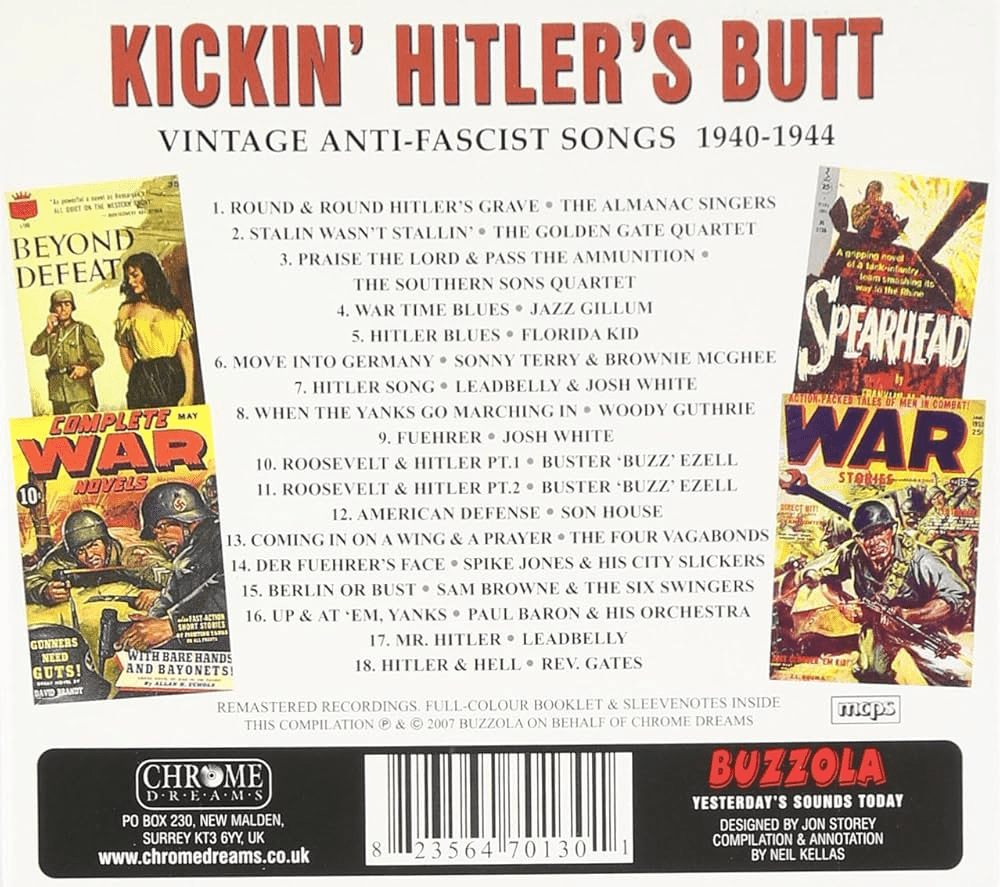
Back Album Cover and Track Listing
The Music
Genres and Styles on the album are impressively varied, including: Jazz, Blues, Brass & Military, Folk, Country, Easy Listening, Big Band Swing, and Acapella Vocal. And there are some big names on this album, including tracks by Lead Belly and Woody Guthrie (two major contenders for Protest Song GOAT), Pete Seeger (with folk supergroups The Almanac Singers and Union Boys), and Josh White, who outdoes them all with his stunning ‘Führer’ (Track 9). Not to mention the most popular track on the album, the zany ‘Der Fuehrer’s Face’ (Track 14), a Walt Disney-produced lampooning of Hitler and the nazi ideal of “der master race” by Spike Jones & His City Slickers.
That’s all I’ll say about the music for now. Come back for the next ten posts for MUCH more on that.
My Approach
First and foremost, although I am a writer and musician, I’m approaching this project as a music fan and, of course, a huge fan of anti-fascism. I came upon this album during a deep dive into American Protest Music, beginning with the protest songs of Lead Belly, which seemed as good a starting point as any. This research will also inform other posts, such as my upcoming ‘How to Write a Protest Song’ series.
What I’m not is any kind of authority on music, WWII, or history in general. Many of you will likely be more educated than I am on some of these topics. Nor am I aiming to write a typical review. Rather, I’ll approach each track as an exploration and a conversation. At times, I may ask questions that I don’t immediately have answers to. You may even be able to help me solve a few mysteries along the way. I encourage feedback and am always open to suggestions. So please, I’d love to hear your thoughts and ideas. All are welcome here!
Links
“Kickin’ Hitler’s Butt” Playlist – YouTube “Kickin’ Hitler’s Butt” Album Page – Discogs “Kickin’ Hitler’s Butt” Album Lyrics – Genius
Special Thanks Go To:
Genius user AndyMeister, who seems to have supplied the lyrics for every track on the album.
Reddit user geshchichtsklitterung from the /blues sub for research assistance.







 Adam Astra